
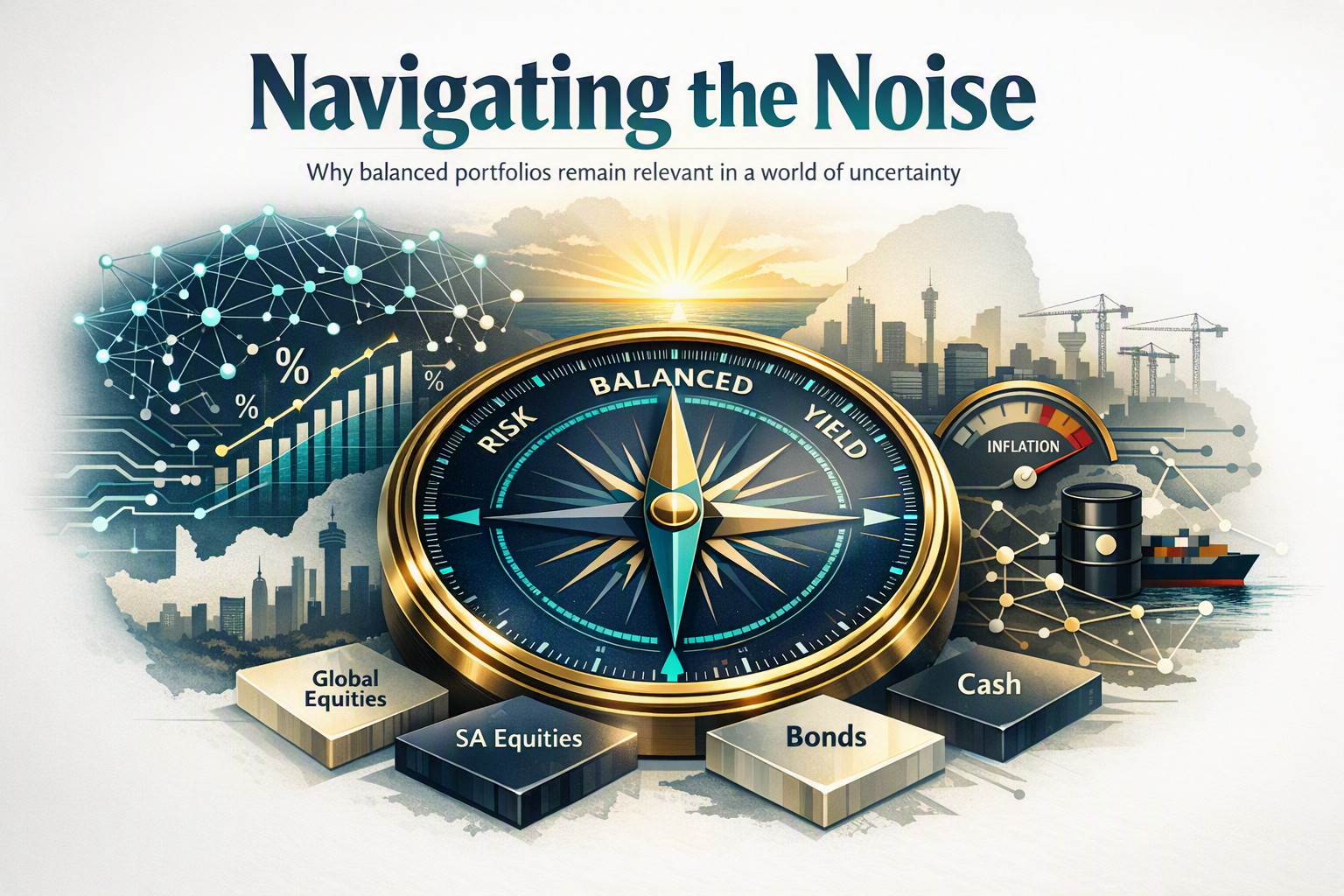
Financial advisers are once again being asked to help clients make sense of a noisy investment environment. The current mix is familiar but uncomfortable: energy-price uncertainty, sticky inflation, cautious central banks, uneven economic growth and powerful technology-led market momentum. In July 2026, the South African Reserve Bank kept its policy rate unchanged at 7%, with the current inflation rate at 5.0% and a 3% inflation target with a one percentage point tolerance band. The SARB also noted that oil prices had rebounded to roughly US$90 per barrel, that South African growth was expected to slow through the second and third quarters, and that headline inflation was expected to remain above 4% until early 2027.
Globally, the story is not one-dimensional either. The IMF projects global growth of 3.0% in 2026 and 3.4% in 2027, but describes the outlook as uneven: the war shock is weighing on energy importers and vulnerable economies, while AI-driven demand is supporting countries linked to the global technology value chain. The IMF also expects global headline inflation to rise from 4.1% in 2025 to 4.7% in 2026, before easing to 3.9% in 2027, which confirms that the disinflation journey has become more complicated.
For advisers, this is not a call to predict the next headline. It is a call to reinforce investment discipline. Recent Index Solutions portfolio-manager insights have repeatedly focused on the same behavioural message: when markets become unsettled, clients look to advisers for clarity; panic-driven exits can turn temporary volatility into permanent loss; and long-term outcomes are more likely to be driven by time in the market than by timing the market. A separate adviser-focused insight also emphasised that the real value of advice lies beyond products or performance — in helping clients navigate uncertainty, behaviour and long-term decision-making.
This is why the Index Solutions Balanced ETF Portfolio is a timely conversation point. The factsheet describes the portfolio as an actively managed, multi-asset investment made up of low-cost JSE-listed ETFs, selected through a disciplined, rules-based quantitative process before capital is allocated according to the portfolio’s risk parameters. It offers exposure across domestic and international equity, fixed income, real estate and money-market assets, while complying with Regulation 28 of the Pension Funds Act. That combination is particularly relevant when clients need both growth participation and risk awareness.itransact
The portfolio’s latest factsheet shows that, as at 30 June 2026, Index Solutions Balanced A delivered 18.68% over one year, 17.57% p.a. over three years and 15.56% p.a. over five years, ahead of its ASISA South African Multi Asset High Equity benchmark over those periods. These numbers should be used responsibly: they provide evidence of historical delivery, not a promise of future returns. The same factsheet states that past performance is not a guide to future performance, that listed securities involve financial risk and costs, and that investors should obtain independent advice before investing.
The current macro backdrop makes diversification especially important. A high policy-rate environment means cash and money-market assets may feel comfortable, but inflation can still erode real purchasing power over time. Bonds can play a role as income and portfolio ballast, but they remain sensitive to inflation expectations and policy-rate changes. Equities remain necessary for long-term real growth, yet clients must accept that both local and global markets can move sharply when geopolitics, oil prices or AI-related valuations change. The Balanced portfolio’s factsheet shows exposure to foreign equity, domestic equity, domestic bonds, money-market assets and foreign bonds, which gives advisers a practical framework for discussing how different return drivers can work together through a cycle.
The key client message is therefore balanced, not promotional: a diversified multi-asset portfolio does not remove volatility, and it is not suitable for every objective or time horizon. The factsheet indicates that the portfolio is designed for investors who prefer a balanced multi-asset strategy, are comfortable with higher levels of investment risk, require higher equity exposure and have a medium-to-long-term savings horizon. That makes suitability and expectation-setting central to the advice discussion.
In uncertain markets, clients often ask, “Should I wait until things settle?” A more useful question is, “Is my portfolio structured for the fact that markets rarely feel settled?” The adviser’s role is to help clients distinguish between noise and strategy. A balanced multi-asset approach is not built around one forecast; it is built because forecasts can be wrong. In a world of sticky inflation, shifting interest rates, energy shocks and AI-driven opportunity, the disciplined response is not panic — it is perspective, diversification and patience.
